zilean’s documentation
Contents:
zilean is designed to facilitate data analysis of the Riot
MatchTimelineDto.
The MatchTimelineDto is a powerful object that contains information
of a specific League of Legends match
at every minute mark. Naturally, the MatchTimelineDto became an
ideal object for various machine learning tasks. For example,
predicting match results using game statistics before the 16 minute
mark.
Different from traditional sports, esports such as League of Legends has
an innate advantage with respect to the data collection process. Since
every play was conducted digitally, it opened up a huge potential to
explore and perform all kinds of data analysis. zilean hopes to
explore the infinite potentials provided by the Riot Games
API, and through the power of
computing, make our community a better place.
GL;HF!
Demo
Here is a quick look of how to do League of Legends data analysis with
zilean
from zilean import TimelineCrawler, SnapShots, read_api_key
import pandas as pd

# Use the TimelineCrawler to fetch `MatchTimelineDto`s
# from Riot. The `MatchTimelineDto`s have game stats
# at each minute mark.

# We need a API key to fetch data. See the Riot Developer
# Portal for more info.
api_key = read_api_key(you_api_key_here)
# Crawl 2000 Diamond RANKED_SOLO_5x5 timelines from the Korean server.
crawler = TimelineCrawler(api_key, region="kr",
                          tier="DIAMOND", queue="RANKED_SOLO_5x5")
result = crawler.crawl(2000, match_per_id=30, file="results.json")
# This will take a long time!

# We will look at the player statistics at 10 and 15 minute mark.
snaps = SnapShots(result, frames=[10, 15])

# Store the player statistics using in a pandas DataFrame
player_stats = snaps.summary(per_frame=True)
data = pd.DataFrame(player_stats)

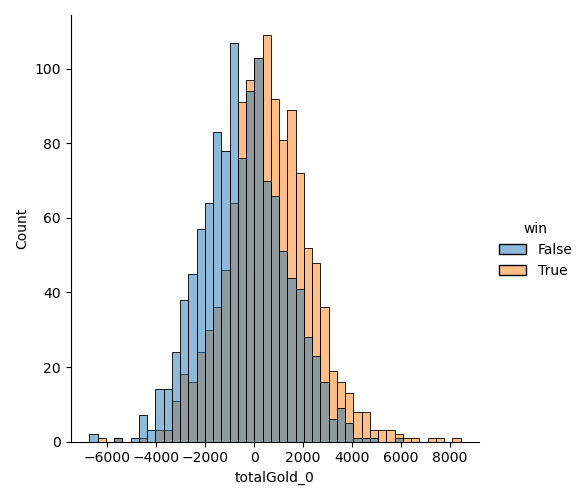
# Look at the distribution of totalGold difference for `player 0` (TOP player)
# at 15 minutes mark.
sns.displot(x="totalGold_0", data=data[data['frame'] == 15], hue="win")
demo_1.png
Here is an example of some quick machine learning.
# Do some simple modelling
from sklearn.model_selection import train_test_split
from sklearn.ensemble import RandomForestClassifier

# Define X and y for training data
train, test = train_test_split(player_stats, test_size=0.33)
X_train = train.drop(["matchId", "win"], axis=1)
y_train = train["win"].astype(int)

# Build a default random forest classifier
rf = RandomForestClassifier()
rf.fit(X_train, y_train)
y_fitted = rf.predict(X_train)
print(f"Training accuracy: {mean(y_train == y_fitted)}")